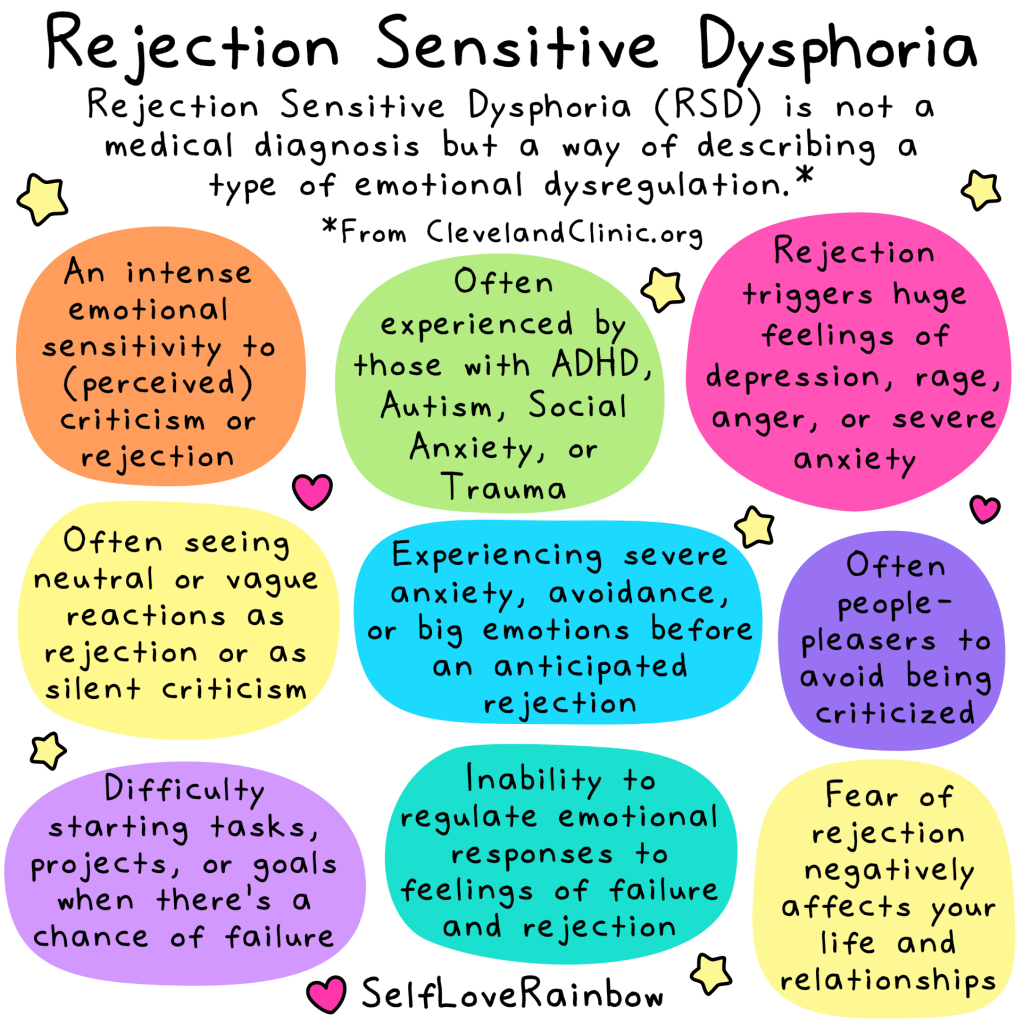
ADHD is a multifaceted disorder, and while its many symptoms and presentations are often discussed, one that may need a closer attention is rejection sensitive dysphoria. RSD is a learned, anticipatory response to perceived interpersonal threat. Simply, it is a reinforced fear of being rejected, insulted, or excluded. And while none of us are indifferent to rejection, those of us who struggle with ADHD may experience a pronounced sensitivity. This sensitivity comes as a result of specific, repeated social experiences, difficulty with emotional regulation, a neurodevelopmental difference in perceiving success and failure.
For many individuals with ADHD, emotional responses are felt with notable intensity and speed. What does this mean? Individuals with ADHD show their emotions very quickly, and often to a great degree. Affect tends to emerge rapidly, often before conscious appraisal has fully formed, and once activated, it can take some time to return to baseline. In social environments, this neurological pattern commonly intersects with a history of frequent correction, misunderstanding, social misattunement, or negative feedback from adults and peers. Over time, these experiences quietly teach the brain to associate interpersonal ambiguity with the possibility of rejection.
As a result, rejection sensitivity is rarely about reacting to clear exclusion, and more about anticipating it. The nervous system reacts as though rejection has already occurred, even when the available information remains incomplete or neutral. The individual becomes highly attuned to cues in interpersonal relationships, such as shifts in tone, delayed responses, fleeting changes in expression, and these cues are quickly interpreted as evidence of disapproval or abandonment. In adolescents with ADHD, this pattern is often intensified by difficulties with emotional regulation and impulse control. Once the perception of rejection is triggered, the emotional response can escalate rapidly, producing shame, anxiety, anger, or sadness that feels overwhelming in proportion to the situation. In such cases, logical reassurance, whether offered internally or by others, tends to have limited effect. This is because such guidance assumes that emotional distress begins at the level of interpretation; in reality, it frequently begins at the level of bodily threat detection. The emotional system activates first; reflection arrives later.
Over time, RSD can quietly shape personality. In adolescents, one may observe behaviors such as seeking constant reassurance, over-apologizing, or people-pleasing in an effort to maintain relational safety. Others move in the opposite direction, withdrawing from relationships, limiting vulnerability, or disengaging preemptively to avoid potential hurt. When it comes to interpersonal relationships, adolescents (and adults) may struggle with accepting and enforcing boundaries, dealing with distance and loss, and accepting major life changes. Once again, these responses are not signs of instability, but adaptive strategies developed by a nervous system attempting to reduce emotional risk.
From a treatment perspective, support does not involve eliminating sensitivity or encouraging emotional detachment, because sensitivity itself is not the problem. Instead, meaningful change comes from strengthening emotional regulation, increasing tolerance for uncertainty, and learning to observe emotional responses without immediately acting on them. Progress is often reflected not in the absence of emotional pain, but in a quicker return to equilibrium after it appears.
Ultimately, RSD reflects the cost of caring deeply about connection in settings where belonging has felt uncertain. For adolescents with ADHD, recognizing this pattern can be an important step toward self-understanding. The goal is not emotional numbness or indifference, but the development of enough internal safety to engage with relationships and feedback without experiencing them as overwhelming threats. Seen through this lens, rejection sensitivity is not a personal failing, but a learned response shaped by experience, and one that can gradually soften as the nervous system learns that not every ambiguous moment signals rejection.
Leave a Reply